
Free Toy Store Helps Needy Families
Free Toy Store Helps Needy Families
子どもたちの笑顔を守りたい、そんな思いから始まった、地域のちょっとユニークな取り組みがあります。この記事では、アメリカのある地域で行われている、思いやりのある支援の形に目を向けてみます。困っている家族が安心して利用できるよう工夫された場には、食べ物や生活に必要なものだけでなく、子どもたちに渡される小さな贈り物が、全体の雰囲気をやさしくしています。もし自分が地域と関わり続けるとしたら、どんな活動がいちばん続けやすいと思いますか?
1.Article
Directions: Read the following article aloud.
Four years ago, country music star Brad Paisley and his wife, actress Kimberly Williams-Paisley, helped create a free food store in Nashville, Tennessee. Their goal was to give families in need the ability to choose their own food in a place that felt like a normal store. They named it The Store.
The Store is a partnership with Nashville’s Belmont University, where Paisley earned his degree.
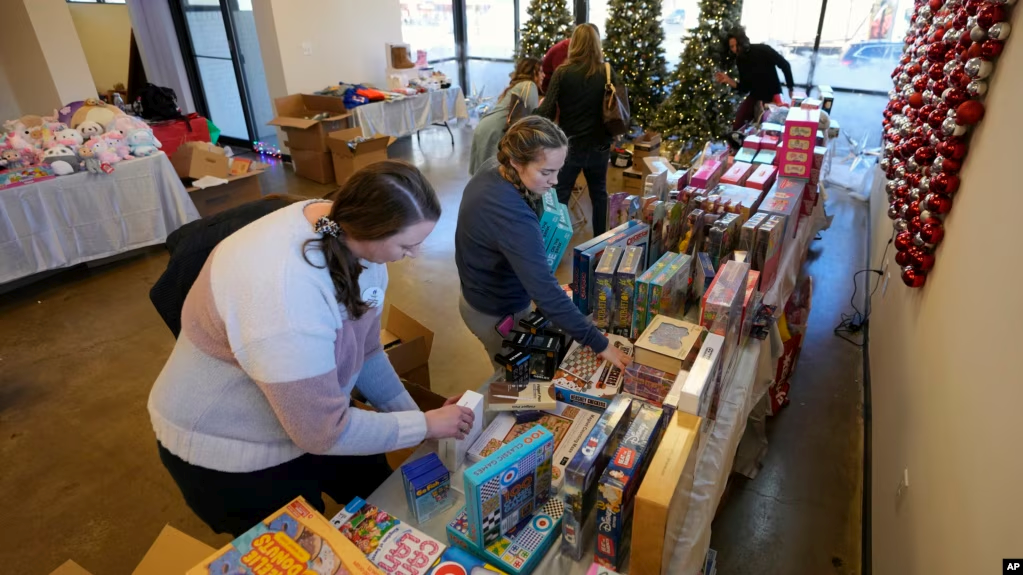
The Store is turning into a free toy store ahead of the Christmas holiday. The event began Friday. For two days, chosen families could pick out new toys, video games, stuffed animals, makeup and other gifts.
Paisley said, “The emotional aspect of being able to give your child something your child wanted versus just something to sort of get you through the holidays…that’s such a load off
the minds of somebody who maybe didn’t think they were going to be able to do that.”
Paisley and Williams-Paisley brought the idea of a free food store to Nashville after seeing a similar effort in California. The Store launched in early 2020. Its opening came just weeks after a powerful tornado hit the area and shortly before the start of the COVID-19 pandemic. The pandemic made food access an urgent problem.
The Store changed its methods to meet people’s needs. It turned into a food delivery service for older people. It delivered one million meals in its first year of operation.
Along with the food store, Belmont University also offers additional services to families in need. They include financial education and music therapy.
“People come on hard times and we want this to be a safe, welcoming place for everybody, whether you’re volunteering or whether you’re needing the services,” Williams-Paisley said. “It’s just a community and we’re all in it together.”
For this year’s toy store event, The Store received about 2,000 donated objects and raised $20,000. Volunteers and workers from Belmont University in Nashville spent hours opening and organizing all of the donated toys into different areas.
Parents will be able to drop off their kids at a religious center nearby, where they can play and drink a hot chocolate. The adults can pick out gifts at the same time.
Paisley said Christmas is his favorite time of year. He said he might even visit The Store dressed as Santa Claus, the make-believe person who brings gifts for children on Christmas.
“I live for this time of year,” Paisley said. “Ever since we’ve had children and possibly even before, I kind of go all out.”
I’m Gregory Stachel.
The Store is a partnership with Nashville’s Belmont University, where Paisley earned his degree.
The Store is turning into a free toy store ahead of the Christmas holiday. The event began Friday. For two days, chosen families could pick out new toys, video games, stuffed animals, makeup and other gifts.
Paisley said, “The emotional aspect of being able to give your child something your child wanted versus just something to sort of get you through the holidays…that’s such a load off
the minds of somebody who maybe didn’t think they were going to be able to do that.”
Paisley and Williams-Paisley brought the idea of a free food store to Nashville after seeing a similar effort in California. The Store launched in early 2020. Its opening came just weeks after a powerful tornado hit the area and shortly before the start of the COVID-19 pandemic. The pandemic made food access an urgent problem.
The Store changed its methods to meet people’s needs. It turned into a food delivery service for older people. It delivered one million meals in its first year of operation.
Along with the food store, Belmont University also offers additional services to families in need. They include financial education and music therapy.
“People come on hard times and we want this to be a safe, welcoming place for everybody, whether you’re volunteering or whether you’re needing the services,” Williams-Paisley said. “It’s just a community and we’re all in it together.”
For this year’s toy store event, The Store received about 2,000 donated objects and raised $20,000. Volunteers and workers from Belmont University in Nashville spent hours opening and organizing all of the donated toys into different areas.
Parents will be able to drop off their kids at a religious center nearby, where they can play and drink a hot chocolate. The adults can pick out gifts at the same time.
Paisley said Christmas is his favorite time of year. He said he might even visit The Store dressed as Santa Claus, the make-believe person who brings gifts for children on Christmas.
“I live for this time of year,” Paisley said. “Ever since we’ve had children and possibly even before, I kind of go all out.”
I’m Gregory Stachel.
Kristin M. Hall reported this story for The Associated Press. Gregory Stachel adapted it for VOA Learning English.
Source:Free Toy Store Helps Needy Families
VOA
本教材は、the U.S. Agency for Global Mediaより許諾を得て、産経ヒューマンラーニング株式会社が編集しています。
テキストの無断転載・無断使用を固く禁じます 。