
Chinese Company Develops Robots with Facial Expressions
Chinese Company Develops Robots with Facial Expressions
中国のある企業が、人の表情をまねるようなロボットづくりに取り組んでいます。感情が伝わる動きやしぐさは、私たちが機械と接するときの印象を大きく変えるかもしれません。便利さだけでなく、安心感や親しみやすさも重要になりそうです。こうした技術が広がる中で、社会にとって何が一番大切だと思いますか。
1.Article
Directions: Read the following article aloud.
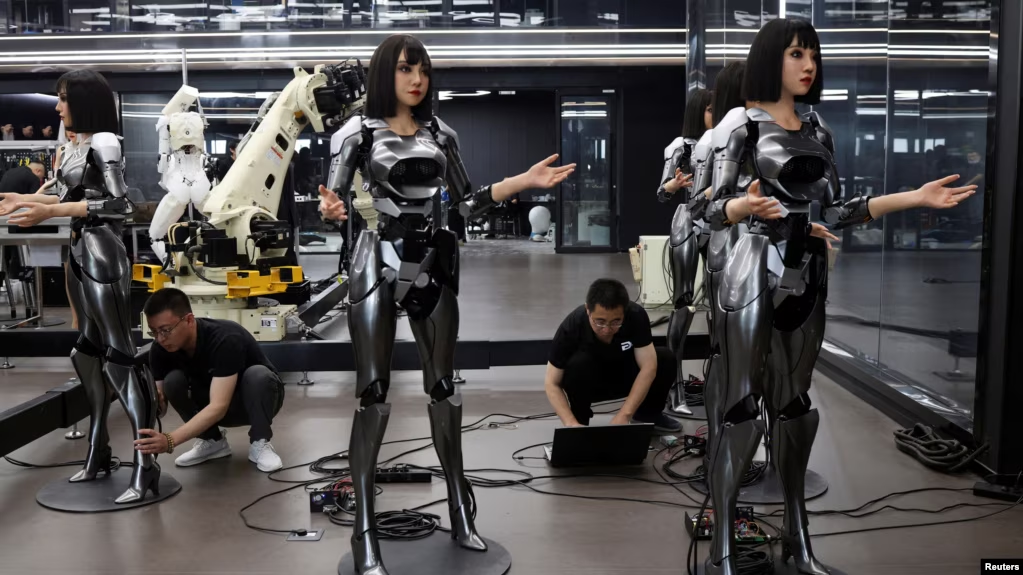
Engineers at the Chinese company Ex-Robots are developing human-like robots at a factory in China’s northeastern coastal city of Dalian. Their goal is to increase the ability of the company’s robots to show facial expressions and emotions.
Robot body parts like arms, feet, and heads are spread out around the factory. The parts are made from a soft, moveable material called silicone. And human-like robots in different stages of construction can be found nearby. Drawings of robot designs are on a wall.
Li Boyang is Ex-Robots chief executive. He said, “We have our own software and algorithm teams.” Algorithms are commands or rules that a computer program follows. Robots need them to operate.
Li said, “There are many basic models and algorithms that are commonly open source, which everyone uses.” Open-source programming is usually freely available to software developers to use in their systems.
But Li said that his company is centering its efforts on how to get the artificial intelligence (AI) “to recognize and express expressions and emotions.”
In a demonstration, for example, an Ex-Robots worker moved her head, smiled, and stuck out her tongue. A human-like robot then copied her movement using small motors placed in several spaces in its head.
Li said, “We are also working on the foundation model. The model we’re making is multi-modal and capable of emotional expression.”
Multi-modal AI can process different kinds of signals and can react to them. For example, a multi-modal system could react to video, text, sound or touch. Li added that it can examine the surrounding environment and produce correct facial feedback.
Ex-Robots said it takes from two weeks to a month to produce a humanoid robot. The robots cost from $207,000 to $276,000.
So far, the robots’ main purpose is to be shown in museums. One of the museums is in the same building as the Ex-Robots factory.
Looking ahead, Li believes human-like robots will have a bigger part to play in the healthcare and education industries.
He said that mental health treatments like psychological counselling are ways these robots will be used in the future. He added that his company is currently researching treatments and information gathering for mental health disorders.
Li said, "Moreover, I believe that emotional interaction has broader applications in service fields, such as those aimed at children."
Robot body parts like arms, feet, and heads are spread out around the factory. The parts are made from a soft, moveable material called silicone. And human-like robots in different stages of construction can be found nearby. Drawings of robot designs are on a wall.
Li Boyang is Ex-Robots chief executive. He said, “We have our own software and algorithm teams.” Algorithms are commands or rules that a computer program follows. Robots need them to operate.
Li said, “There are many basic models and algorithms that are commonly open source, which everyone uses.” Open-source programming is usually freely available to software developers to use in their systems.
But Li said that his company is centering its efforts on how to get the artificial intelligence (AI) “to recognize and express expressions and emotions.”
In a demonstration, for example, an Ex-Robots worker moved her head, smiled, and stuck out her tongue. A human-like robot then copied her movement using small motors placed in several spaces in its head.
Li said, “We are also working on the foundation model. The model we’re making is multi-modal and capable of emotional expression.”
Multi-modal AI can process different kinds of signals and can react to them. For example, a multi-modal system could react to video, text, sound or touch. Li added that it can examine the surrounding environment and produce correct facial feedback.
Ex-Robots said it takes from two weeks to a month to produce a humanoid robot. The robots cost from $207,000 to $276,000.
So far, the robots’ main purpose is to be shown in museums. One of the museums is in the same building as the Ex-Robots factory.
Looking ahead, Li believes human-like robots will have a bigger part to play in the healthcare and education industries.
He said that mental health treatments like psychological counselling are ways these robots will be used in the future. He added that his company is currently researching treatments and information gathering for mental health disorders.
Li said, "Moreover, I believe that emotional interaction has broader applications in service fields, such as those aimed at children."
Gregory Stachel adapted this Reuters story for VOA Learning English.
Source:Chinese Company Develops Robots with Facial Expressions
VOA
本教材は、the U.S. Agency for Global Mediaより許諾を得て、産経ヒューマンラーニング株式会社が編集しています。
テキストの無断転載・無断使用を固く禁じます 。