
An Italian Shop in Rome Is Behind 17 Academy Awards
An Italian Shop in Rome Is Behind 17 Academy Awards
映画を見ていて、「この服、印象に残るな」と感じたことはありませんか。衣装は登場人物の性格や物語の雰囲気を、言葉以上に伝えていることがあります。でも、その服がどんな場所で、どんな人の手で作られているかを考える機会は多くありません。衣装が物語に与える影響について、あなたはどう思いますか。
1.Article
Directions: Read the following article aloud.
In many movies, the clothing the actors wear is an important part of the story. In Rome, there is a workshop that has been a big part of Italian and international film history for 60 years.
Tirelli Costumes in Rome’s Prati neighborhood is an atelier, a business that makes special clothing and costumes. It has earned the nickname the “Oscar tailor’s shop” for its work in film costume design. An “Oscar” is another name for an award from the Academy of Motion Picture Arts and Sciences.
Umberto Tirelli started the shop in November 1964. It has been behind 17 Academy Awards for best costume design. Most recently, its workers helped create the costumes for Ridley Scott's movie Napoleon. The film’s costume designers were nominated for an Oscar that will be decided at the Academy Awards in Hollywood this weekend.
“Maybe it will win! Let’s add another medal to the medal collection,” the shop's current head, Dino Trappetti, told The Associated Press. “Of course, the Oscar is not won by the tailor’s shop, the Oscar is won by the costume designer. But the tailor’s shop has the merit and the honor of having participated to make it win.”
The beginning of the atelier started with Tirelli’s passion for collecting old clothes. He searched for clothing in houses of nobility and flea markets worldwide. He slowly built a collection that now has more than 15,000 real pieces of clothing that date from 1750 to 1980.
At the start, the shop had “a sewing machine, two cutters and two other seamstresses,” Trappetti said.
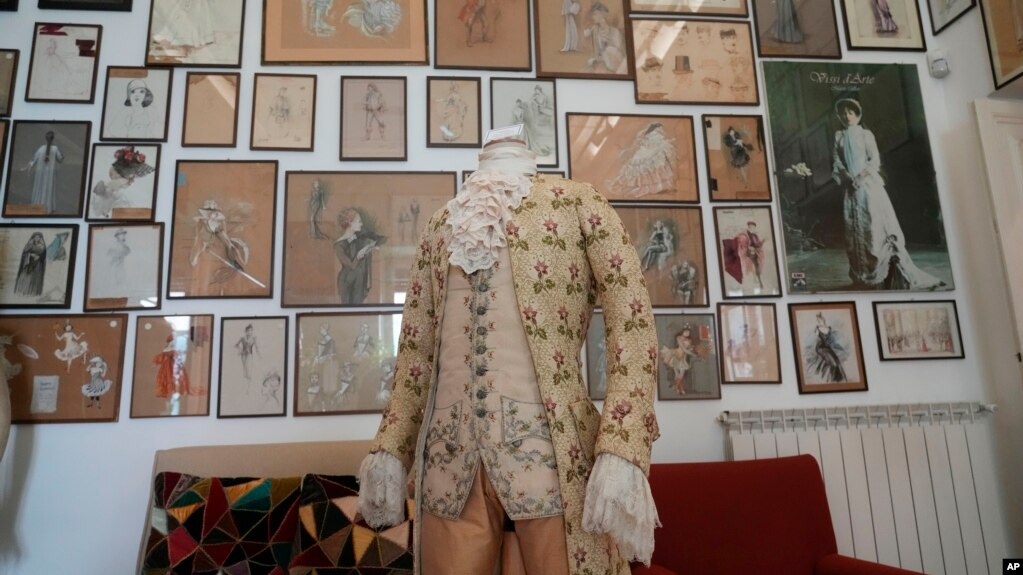
Today, the headquarters of Tirelli Costumes has mannequins wearing some of the atelier's most famous creations: A pink flowered outfit that actor Tom Hulce wore as Wolfgang Amadeus Mozart in Amadeus, and the red outfit Michelle Pfeiffer wore in The Age of Innocence. The designers of each of those pieces of clothing won Oscars.
After the 1984 costume design Oscar for Amadeus, Tirelli could have accepted many international projects “because the market was immediately interested," Trappetti said. But Tirelli, who died in 1990, was not sure.
Trappetti remembered him saying: “I’m not going to America. If America wants, America will come looking for me.”
Over 60 years, the tailor’s shop has created more than 300,000 costumes that are now stored near Rome. Costume designers come for ideas and historical information. They also come for hand-cut, hand-sewn creations by the team of Tirelli workers.
“You can’t make those costumes in a factory. In a factory you can make films with robots, futuristic or fantasy," Trappetti said.” ‘But these things have to be made by hand.”
Tirelli Costumes in Rome’s Prati neighborhood is an atelier, a business that makes special clothing and costumes. It has earned the nickname the “Oscar tailor’s shop” for its work in film costume design. An “Oscar” is another name for an award from the Academy of Motion Picture Arts and Sciences.
Umberto Tirelli started the shop in November 1964. It has been behind 17 Academy Awards for best costume design. Most recently, its workers helped create the costumes for Ridley Scott's movie Napoleon. The film’s costume designers were nominated for an Oscar that will be decided at the Academy Awards in Hollywood this weekend.
“Maybe it will win! Let’s add another medal to the medal collection,” the shop's current head, Dino Trappetti, told The Associated Press. “Of course, the Oscar is not won by the tailor’s shop, the Oscar is won by the costume designer. But the tailor’s shop has the merit and the honor of having participated to make it win.”
The beginning of the atelier started with Tirelli’s passion for collecting old clothes. He searched for clothing in houses of nobility and flea markets worldwide. He slowly built a collection that now has more than 15,000 real pieces of clothing that date from 1750 to 1980.
At the start, the shop had “a sewing machine, two cutters and two other seamstresses,” Trappetti said.
Today, the headquarters of Tirelli Costumes has mannequins wearing some of the atelier's most famous creations: A pink flowered outfit that actor Tom Hulce wore as Wolfgang Amadeus Mozart in Amadeus, and the red outfit Michelle Pfeiffer wore in The Age of Innocence. The designers of each of those pieces of clothing won Oscars.
After the 1984 costume design Oscar for Amadeus, Tirelli could have accepted many international projects “because the market was immediately interested," Trappetti said. But Tirelli, who died in 1990, was not sure.
Trappetti remembered him saying: “I’m not going to America. If America wants, America will come looking for me.”
Over 60 years, the tailor’s shop has created more than 300,000 costumes that are now stored near Rome. Costume designers come for ideas and historical information. They also come for hand-cut, hand-sewn creations by the team of Tirelli workers.
“You can’t make those costumes in a factory. In a factory you can make films with robots, futuristic or fantasy," Trappetti said.” ‘But these things have to be made by hand.”
Dan Novak adapted this story for VOA Learning English based on reporting by The Associated Press.
Source:An Italian Shop in Rome Is Behind 17 Academy Awards
VOA
本教材は、the U.S. Agency for Global Mediaより許諾を得て、産経ヒューマンラーニング株式会社が編集しています。
テキストの無断転載・無断使用を固く禁じます 。