
Study: Climate Change Diet Not Good for Polar Bears
Study: Climate Change Diet Not Good for Polar Bears
2氷に覆われた海の上を、ホッキョクグマがゆっくりと歩いています。広い白い世界の中で、食べ物を探す姿はとても印象的です。そんな環境で生きる彼らの食事には、独特の特徴があります。最近では、その食生活に少し違いが見られるとも言われています。環境と食べ物の関係は、どのように変わっていくのでしょうか。
1.Article
Directions: Read the following article aloud.
A new study suggests that the climate change diet might not be good for polar bears.
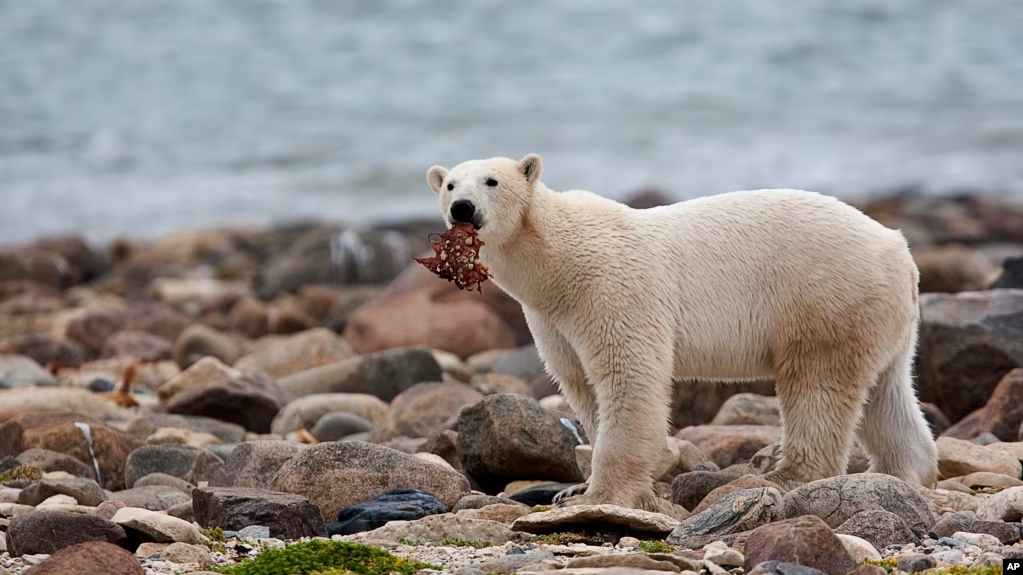
With Arctic sea ice declining, many polar bears have to go to land for their diets during parts of the summer.
A study looking at Hudson Bay polar bears tried to figure out if the creatures can keep their healthy weight levels on such a diet.
Researchers found that the majority of the creatures are losing weight no matter what they do to try to increase it.
Some bears find a lot of food — berries, eggs, sea birds and even caribou antlers. But such foods take a lot of effort. The bears use so many calories trying to eat that they end up losing weight and burning more energy than they take in, the study says.
The findings appeared recently in the publication Nature Communications.
Other bears go into a time of semi-hibernation. But they also lose weight.
So either way – eating different foods or sleeping a lot – does not work, said the study’s lead writer Anthony Pagano of the U.S. Geological Survey.
Researchers found that 19 of the 20 bears studied dropped an average of 21 kilograms over three weeks of being studied. The research observed their calorie intake, energy use and respiration in the wild.
The bears lost about 7 percent of their body mass on average in just 21 days, the study found.
Polar bears try to keep up their weight in the summer after a spring when they eat a lot and gain weight. In the area of the Hudson Bay where researchers studied, lack of sea ice has meant polar bears are on land three weeks longer than in the 1980s, Pagano said.
Usually, polar bears eat high-fat seals while based on sea ice near where the seals are. Hunting is especially good in the spring when seal pups are young and have not yet learned to swim away from the ice base, Pagano said.
Last September, when Arctic sea ice hit its yearly low, there was about 2.6 million square kilometers less sea ice than the same time in 1979, the National Snow and Ice Data Center says. The United States Fish and Wildlife Service lists polar bears as a threatened species “due to the loss of its sea ice habitat.”
“This paper clearly shows that polar bears cannot adapt to the pace of change in the Arctic and that the bears are already using everything they have to stay alive,’' said University of Alberta biologist Andrew Derocher. Derocher was not part of the research but suggested it was important and done well.
“This is concerning because of course it really does raise the question of when will the individual bears run out of energy,” Derocher said. While research shows that some of the bears will survive, “other bears were basically right on the edge of where they would potentially suffer from starvation and subsequent death.”
Overall, the research shows that it is unlikely polar bears can adapt to living on land, Derocher said.
With Arctic sea ice declining, many polar bears have to go to land for their diets during parts of the summer.
A study looking at Hudson Bay polar bears tried to figure out if the creatures can keep their healthy weight levels on such a diet.
Researchers found that the majority of the creatures are losing weight no matter what they do to try to increase it.
Some bears find a lot of food — berries, eggs, sea birds and even caribou antlers. But such foods take a lot of effort. The bears use so many calories trying to eat that they end up losing weight and burning more energy than they take in, the study says.
The findings appeared recently in the publication Nature Communications.
Other bears go into a time of semi-hibernation. But they also lose weight.
So either way – eating different foods or sleeping a lot – does not work, said the study’s lead writer Anthony Pagano of the U.S. Geological Survey.
Researchers found that 19 of the 20 bears studied dropped an average of 21 kilograms over three weeks of being studied. The research observed their calorie intake, energy use and respiration in the wild.
The bears lost about 7 percent of their body mass on average in just 21 days, the study found.
Polar bears try to keep up their weight in the summer after a spring when they eat a lot and gain weight. In the area of the Hudson Bay where researchers studied, lack of sea ice has meant polar bears are on land three weeks longer than in the 1980s, Pagano said.
Usually, polar bears eat high-fat seals while based on sea ice near where the seals are. Hunting is especially good in the spring when seal pups are young and have not yet learned to swim away from the ice base, Pagano said.
Last September, when Arctic sea ice hit its yearly low, there was about 2.6 million square kilometers less sea ice than the same time in 1979, the National Snow and Ice Data Center says. The United States Fish and Wildlife Service lists polar bears as a threatened species “due to the loss of its sea ice habitat.”
“This paper clearly shows that polar bears cannot adapt to the pace of change in the Arctic and that the bears are already using everything they have to stay alive,’' said University of Alberta biologist Andrew Derocher. Derocher was not part of the research but suggested it was important and done well.
“This is concerning because of course it really does raise the question of when will the individual bears run out of energy,” Derocher said. While research shows that some of the bears will survive, “other bears were basically right on the edge of where they would potentially suffer from starvation and subsequent death.”
Overall, the research shows that it is unlikely polar bears can adapt to living on land, Derocher said.
Seth Borenstein reported on this story for the Associated Press. John Russell adapted it for VOA Learning English.
Source:Study: Climate Change Diet Not Good for Polar Bears
VOA
本教材は、the U.S. Agency for Global Mediaより許諾を得て、産経ヒューマンラーニング株式会社が編集しています。
テキストの無断転載・無断使用を固く禁じます 。